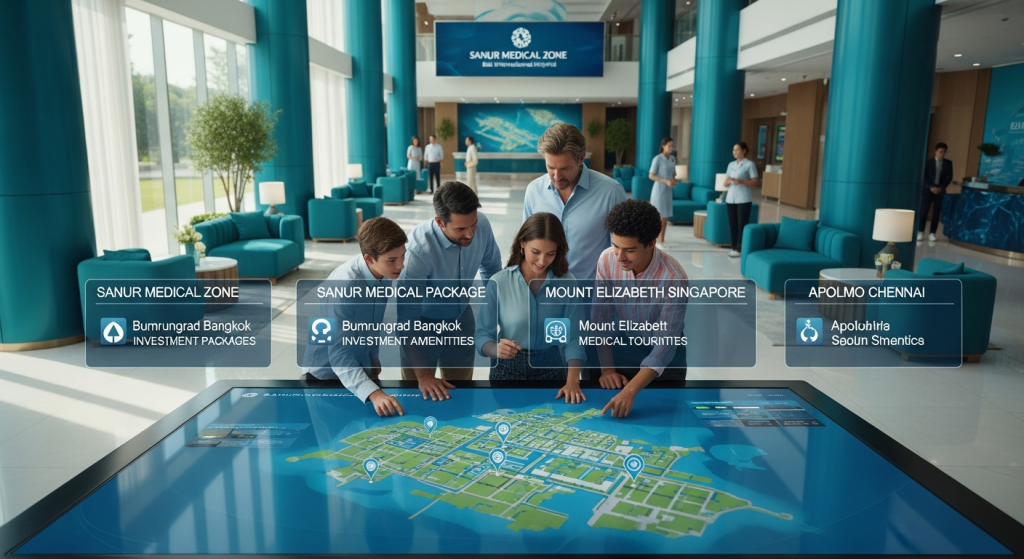
- Strategic SEZ status provides significant investment incentives and operational advantages.
- Partnership with Mayo Clinic affiliate IHC ensures world-class medical standards and technology.
- Holistic approach combines advanced medical treatments with Bali’s renowned wellness ethos.
The gentle breeze carries the scent of frangipani blossoms across the Sanur coastline, a whisper of Bali’s enduring allure. Here, where turquoise waters meet golden sands, a transformative vision takes shape, redefining global luxury medical travel.
The Vision of Sanur Medical Zone: A New Horizon for Healthcare
Sanur Medical Zone emerges not merely as a hospital but as a meticulously planned medical ecosystem, a bold initiative by the Indonesian government to position Bali at the forefront of international medical tourism. Designated as a Special Economic Zone (SEZ) in 2022, this 41-hectare precinct on Bali’s southeast coast offers a unique confluence of advanced medical infrastructure and an idyllic recovery environment. Investors recognize the strategic advantage of SEZ status, which includes tax holidays, import duty exemptions, and streamlined permits, fostering an attractive climate for healthcare enterprises. The core of this development is the Bali International Hospital, a 250-bed facility operated by Indonesia Healthcare Corporation (IHC) in collaboration with a Mayo Clinic affiliate, setting a new benchmark for clinical excellence in the region. This partnership ensures adherence to global best practices, with a focus on specialties like cardiology, oncology, neurology, and orthopedics, addressing a significant gap in high-quality specialized care previously sought abroad by Indonesian and regional patients. The projected investment for the initial phase exceeds $100 million USD, demonstrating a robust commitment to infrastructure and technology. Beyond the hospital, the Sanur Medical Zone integrates a network of specialized clinics, rehabilitation centers, and wellness resorts, creating a comprehensive health and healing destination. This integrated approach, backed by government policy and private sector expertise, positions Sanur as a compelling alternative to established medical tourism hubs, offering both superior medical outcomes and an unmatched patient experience. The zone is designed to attract over 500,000 medical tourists annually by 2030, a testament to its ambitious scope and potential impact on regional healthcare dynamics. For more information on Indonesia’s SEZs, consult Wikipedia’s entry on Indonesian SEZs.
Medical Expertise and Technology: Elevating Standards in Southeast Asia
The commitment to world-class medical expertise within the Sanur Medical Zone is evident in its strategic partnerships and planned technological infrastructure. Unlike many established regional hospitals that have evolved over decades, Sanur Medical Zone is designed from the ground up to incorporate the latest advancements in medical science and digital health. The collaboration with a Mayo Clinic affiliate through IHC signifies a direct transfer of knowledge, protocols, and operational excellence, ensuring that patient care pathways, diagnostic capabilities, and treatment modalities meet international gold standards. This includes advanced imaging technologies such as 3T MRI and PET-CT scanners, state-of-the-art operating theaters equipped for minimally invasive surgeries, and dedicated units for complex procedures like cardiac catheterization and robotic-assisted surgery. The focus extends beyond equipment to human capital, with plans for attracting highly skilled international and local specialists, supported by continuous medical education programs. For instance, the Bali International Hospital aims for Joint Commission International (JCI) accreditation within its first three years of operation, a global benchmark for patient safety and quality. Comparisons with regional leaders like Bumrungrad International Hospital in Bangkok or Mount Elizabeth Hospital in Singapore often highlight their long-standing reputations. However, Sanur offers the advantage of purpose-built facilities incorporating contemporary design and technology, free from the constraints of legacy infrastructure. The zone also prioritizes data integration and telemedicine, creating a seamless patient journey from initial consultation to post-treatment follow-up, a critical differentiator in today’s connected world. The projected capacity includes over 10 specialized centers of excellence, each staffed by experts in their respective fields, ensuring comprehensive care across a broad spectrum of medical needs. This forward-looking approach to medical technology and expertise positions Sanur not just as a competitor, but as an innovator in the regional healthcare landscape.
Lifestyle Integration and Patient Experience: Healing by the Ocean
What truly distinguishes the Sanur Medical Zone is its seamless integration with Bali’s renowned lifestyle and healing environment. Medical travel often entails a sterile, urban experience, with recovery confined to hospital rooms or city hotels. Sanur reimagines this paradigm. Here, post-operative recovery transcends the clinical, extending into bespoke wellness villas and resorts situated within the SEZ, many offering direct access to the tranquil Sanur beach. Patients and their accompanying families benefit from a holistic approach to healing, where the island’s natural beauty and cultural serenity become integral to the recovery process. Imagine physiotherapy sessions overlooking manicured gardens, or guided meditation on a private terrace as the sun rises over the Indian Ocean. The zone’s design incorporates green spaces, walking paths, and proximity to cultural attractions like the Le Mayeur Museum, located just 2 kilometers away, offering gentle diversions during convalescence. This contrasts sharply with the bustling cityscapes surrounding hospitals in Singapore or Kuala Lumpur, where the urban environment can feel overwhelming for patients seeking respite. Bali’s established tourism infrastructure, with its abundance of luxury accommodations, world-class dining, and diverse recreational activities, provides an unparalleled support system for medical tourists. Ngurah Rai International Airport (DPS) is just a 20-minute drive, ensuring convenient access for international arrivals from over 40 direct routes. The Sanur Medical Zone capitalizes on Bali’s existing reputation as a wellness destination, elevating it with advanced medical care. This unique blend of high-tech medicine and high-touch hospitality creates an environment where physical healing is complemented by mental and emotional well-being, fostering a more complete and restful recovery journey. Explore Bali’s cultural richness at Indonesia.travel.
Investment Landscape: Real Estate and Growth Potential
For investors, the Sanur Medical Zone represents a compelling opportunity within a rapidly expanding sector. The SEZ designation grants a suite of fiscal and non-fiscal incentives designed to attract both domestic and international capital. These benefits include corporate income tax reductions of up to 100% for certain periods, import duty exemptions on capital goods, and simplified licensing procedures, significantly reducing operational complexities and enhancing profitability. The medical real estate cluster within the zone is diverse, encompassing plots for specialized clinics, long-term care facilities, recovery villas, luxury medical hotels, and staff accommodation. Demand for high-quality medical facilities in Indonesia is robust, driven by a growing middle class and an increasing preference for domestic, high-standard care over overseas travel. The government projects the medical tourism market in Indonesia to grow at a compound annual growth rate (CAGR) of over 15% through 2027. Property values in Bali, particularly in designated growth areas like Sanur, have historically shown strong appreciation, with average annual returns on investment often exceeding 8% for well-managed properties. The strategic location, coupled with the integrated nature of the zone, creates a symbiotic relationship between medical providers and hospitality services, ensuring a steady stream of patients and their families requiring accommodation and ancillary services. This makes investments in recovery villas or medical-grade serviced apartments particularly attractive. Furthermore, the long-term vision for the Sanur Medical Zone includes research and development facilities, potentially attracting pharmaceutical companies and biotech startups, diversifying the investment portfolio. The government’s commitment to infrastructure development, including improved road networks and utilities within the SEZ, further de-risks real estate investments. Regional family offices and hospital expansion planners seeking a strategic footprint in Southeast Asia find the Sanur Medical Zone’s unique blend of government support, high-growth market, and luxury destination appeal an unmatched proposition for long-term capital appreciation and impact.
Accessibility and Connectivity: Bali as a Global Gateway
Bali’s intrinsic global appeal and robust connectivity significantly enhance the Sanur Medical Zone’s competitive edge. Ngurah Rai International Airport (DPS), consistently ranked among the world’s best airports, serves as a major hub for Southeast Asia and Australasia, offering direct flights to over 40 international cities across Asia, Australia, and Europe. This extensive network ensures seamless travel for medical tourists from key markets such as Australia, Singapore, Malaysia, and beyond. In 2023, DPS recorded over 20 million passenger movements, underscoring its capacity and efficiency. The Indonesian government has also streamlined visa processes, offering visa-on-arrival for citizens of many countries and e-visa options, simplifying entry for medical travelers. This ease of access contrasts with some medical hubs that require more complex visa applications or multiple transit points. Once in Bali, the Sanur Medical Zone is strategically located just 15-20 minutes from the airport, minimizing travel time and stress for patients. The island’s well-developed transportation infrastructure, including reliable private transfer services, ensures comfortable and efficient movement within the zone and to surrounding areas. For patients requiring extended stays, Bali offers a diverse range of accommodations, from five-star resorts to private villas, catering to various budgets and preferences, all within close proximity to the medical facilities. This level of accessibility and convenience is a critical factor for medical tourism, where patients often prioritize a hassle-free journey. The island’s reputation as a safe and welcoming destination further enhances its appeal, providing peace of mind for international visitors. The Sanur Medical Zone leverages Bali’s established global brand, transforming it into a gateway for world-class healthcare, accessible to a broad international audience. The convenience of combining advanced medical care with a recovery period in a globally recognized tourism destination is a powerful draw.
Regional Competitors: A Strategic Overview and Sanur’s Distinct Advantages
When evaluating the Sanur Medical Zone against established regional medical tourism hubs, a nuanced picture emerges. Destinations like Bangkok, Singapore, and Kuala Lumpur have built formidable reputations over decades, boasting high patient volumes and a breadth of specialized services. Bumrungrad International Hospital in Bangkok, for instance, treats over 1.1 million patients annually, with nearly half being international. Singapore’s Mount Elizabeth Hospital and Gleneagles Hospital are renowned for complex surgeries and highly specialized treatments, often at a premium cost. These established centers offer a proven track record and extensive experience. However, Sanur presents distinct advantages. As a purpose-built SEZ, it benefits from contemporary infrastructure and a forward-thinking design, avoiding the challenges of retrofitting older facilities. The collaboration with a Mayo Clinic affiliate positions Sanur at the apex of medical quality from its inception, a level of direct affiliation not commonly found elsewhere in the region. While competitors are often situated in dense urban environments, Sanur offers a unique blend of advanced medical care within Bali’s tranquil, healing landscape. This integrated wellness approach, where recovery is intertwined with nature and culture, is a significant differentiator. Patients seeking anonymity, serenity, and a holistic recovery experience find Sanur’s offering unparalleled. Furthermore, the SEZ status provides compelling investment incentives that are often absent in more mature markets, making Sanur an attractive proposition for new clinic development or expansion. While Sanur is a newer entrant, it is not merely replicating existing models; it is innovating by combining medical excellence with a deeply integrated wellness and lifestyle component. The focus on specific high-demand specialties like stem cell therapy, IVF, and advanced cardiology, coupled with an emphasis on preventive care and anti-aging, positions Sanur to capture a distinct segment of the luxury medical tourism market. The cost structure, while premium, is designed to be competitive with top-tier international care, often offering significant value when considering the comprehensive recovery environment and amenities.
The Future Trajectory: Innovation, Research, and Expansion
The vision for the Sanur Medical Zone extends far beyond its initial operational phase; it is conceived as a dynamic hub for medical innovation and research in Southeast Asia. Future plans include the establishment of dedicated research centers focusing on emerging fields such as regenerative medicine, personalized oncology, and advanced diagnostics. Partnerships with international academic institutions are being actively pursued to foster a collaborative environment for medical breakthroughs. For example, discussions are underway for a specialized stem cell research facility, leveraging Bali’s unique biodiversity and a projected annual research budget of $20 million USD. The SEZ framework provides an ideal ecosystem for these endeavors, offering regulatory support and access to a skilled workforce. Expansion phases anticipate additional specialized clinics, a medical university, and a pharmaceutical manufacturing cluster, transforming the zone into a comprehensive medical science park. This long-term strategic outlook aims to attract leading medical professionals, scientists, and entrepreneurs, creating a vibrant community dedicated to advancing healthcare. The integration of telemedicine and AI-driven diagnostics will continue to evolve, ensuring that the Sanur Medical Zone remains at the cutting edge of global medical practice. This commitment to continuous innovation not only benefits patients by providing access to the latest treatments but also positions the zone as a magnet for medical talent and investment. The government’s long-term commitment, combined with the strategic foresight of IHC and its partners, ensures that the Sanur Medical Zone will not only meet the current demands of luxury medical tourism but will also shape the future of healthcare in the region for decades to come, solidifying Bali’s place on the global medical map. UNESCO World Heritage sites in Bali, like the Subak system, reflect the island’s rich heritage and potential for a holistic healing journey, further enhancing the zone’s appeal.
The Sanur Medical Zone stands as a testament to Bali’s evolving narrative, a place where profound healing meets unparalleled serenity. For investors seeking impactful opportunities in medical real estate, for patients desiring world-class care within a restorative environment, and for healthcare innovators charting future pathways, Sanur offers a definitive answer. Discover the full scope of this visionary project and explore how you can be part of Bali’s medical future. Visit SanurMedicalZone.com today to learn more about investment opportunities and patient services.